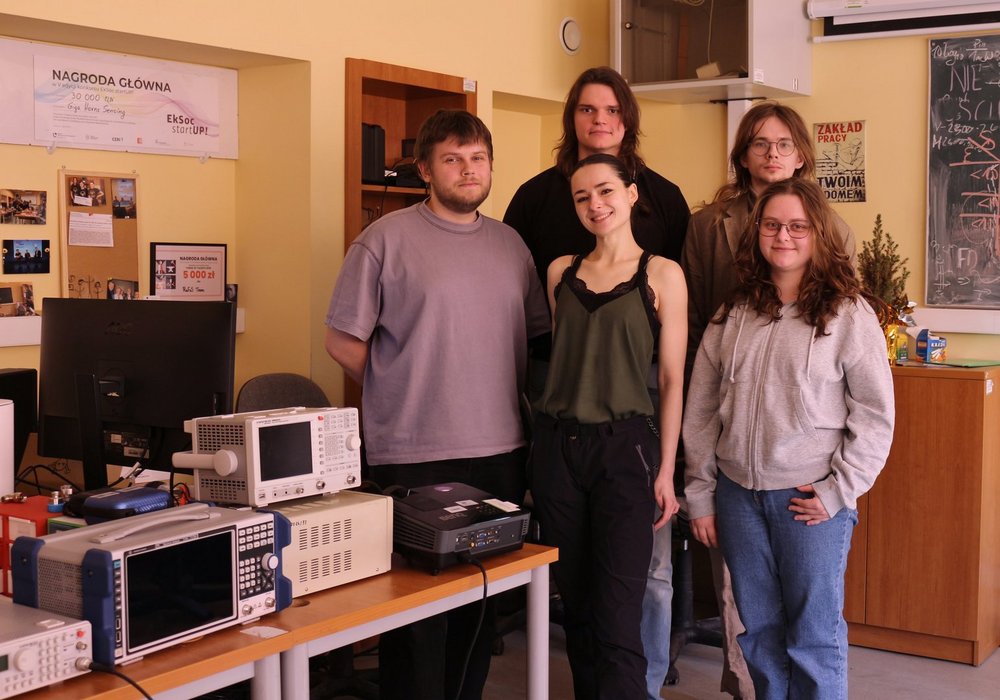
As part of the programme, its winners receive up to €1,000 for the purchase of tools, modules and electronic components necessary for prototyping and research and development.
The project, carried out by the club members, involves developing a new method for assessing muscle tone in newborns. Hypotonia, or reduced muscle tone is one of the most common motor problems in infants. Early detection of this disorder is crucial, as untreated hypotonia can lead to conditions such as abnormal body position, skull deformation and postural problems later in life.
Currently applied diagnostic methods have significant limitations. Clinical scales used by physicians rely largely on subjective assessment by the specialist, while electromyography (EMG), which measures electrical muscle activity, requires patient cooperation, making its use in newborns difficult.
The students are developing a solution using a microstrip line probe to measure muscle impedance using electromagnetic fields in the gigahertz frequency range. Research indicates that changes in muscle impedance may be associated with decreased muscle tone.
The developed method has the potential to enable objective and safe diagnosis of muscle tone, without the need for subjective interpretation of results. In a later stage of the project, we also plan to develop algorithms for automatic detection of flaccidity syndrome in infants..
Low cost, resulting from the use of readily available electronic components that can be integrated on a single printed circuit board, is an additional advantage of the proposed solution.
Currently, the club's members are conducting phantom measurements, which will allow for preliminary verification of the developed measurement method.
The obtained grant will enable the purchase of equipment such as meters, microcontrollers and electronic modules, which will be used to build prototypes and develop students' practical competencies in electronics and biomedical engineering.